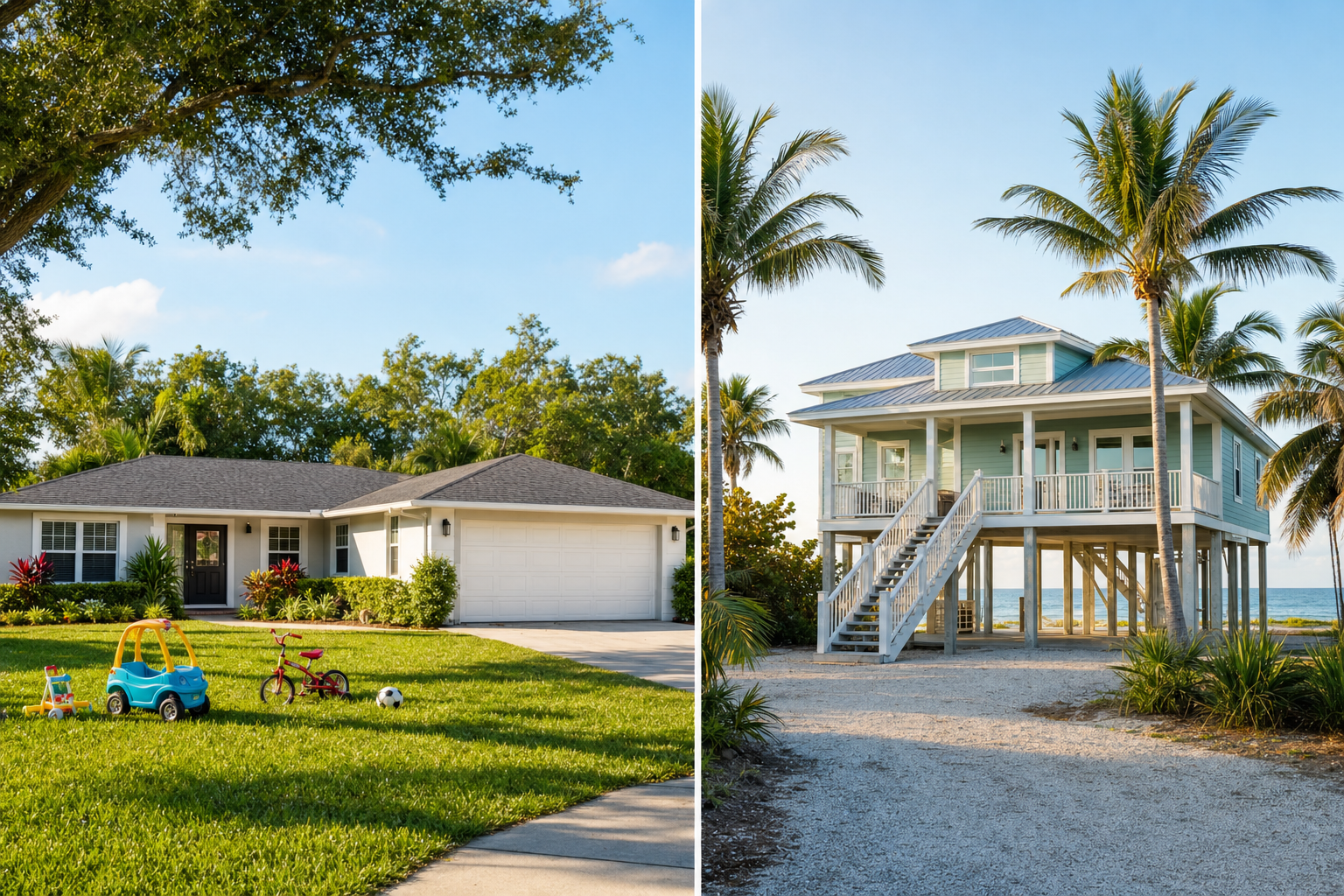

Homeowners insurance in Florida
Florida homeowners pay 2.5x to 4x the national average. The reasons: hurricane exposure, litigation history, roof-replacement costs, and reinsurance markets. The good news for 2026: Governor DeSantis announced rate reductions and Citizens Property Insurance is cutting rates by an average 8.7% statewide.
What it costs in 2026
| Region | Annual Premium Range | 2026 Trend |
|---|---|---|
| North Florida (Duval, Alachua) | $2,100 – $3,400 | Stable |
| Central Florida (Orlando) | $2,800 – $4,200 | Stable |
| Tampa Bay / Manatee / Sarasota | $3,800 – $5,500 | Stable to slightly decreasing |
| Southwest Florida (Lee, Collier) | $4,800 – $7,000 | Decreasing (post-Ian recovery) |
| South Florida (Miami-Dade, Broward) | $5,500 – $8,300 | Decreasing (Citizens cuts 11.9% – 14.1%) |
| Florida Keys (Monroe) | $7,000 – $18,000+ | Still very high |
Source: Compiled from Atesa Risk Advisors, Insurify 2026 report, and Florida OIR filings.
What drives your premium
- Location: Distance to coast, wind zone, flood zone, county
- Home age & roof age: Roofs over 15 years often trigger limited coverage or ACV settlements — see the 4-point inspection chapter for age thresholds
- Construction: Concrete block (CBS) beats frame construction; hip roof beats gable
- Wind mitigation features: Documented on OIR-B1-1802 form — see how to cut your premium 25% – 45%
- Claims history: Both yours and the property's (CLUE report)
- Deductibles: Separate hurricane deductible (usually 2% – 5% of dwelling value)
The hurricane deductible surprise
Your policy has two deductibles: a regular all-perils deductible ($1,000 – $2,500) and a separate hurricane deductible that applies only to named-storm damage. Hurricane deductibles are calculated as a percentage of your dwelling coverage, not a flat dollar amount. On a $500,000 dwelling with a 2% hurricane deductible, you'd owe the first $10,000 before insurance pays anything for hurricane damage.
Citizens Property Insurance — the insurer of last resort
Created by the Florida Legislature, Citizens writes policies for homeowners who can't get coverage in the private market. About 228,000+ Florida homes are on Citizens as of 2026. Key things to know:
- If a private carrier offers coverage within 20% of the Citizens premium, you must accept it and leave Citizens
- New Citizens policyholders with $400,000+ dwelling coverage must carry separate flood insurance as of January 1, 2026
- Citizens is generally not the cheapest option — private carriers should always be shopped first
Flood insurance in Florida

Standard homeowners insurance does not cover flood damage. This surprises new Florida buyers more than any other insurance issue. Flooding is covered separately through the National Flood Insurance Program (NFIP) or a growing private flood market.
When flood insurance is required
- Federally-backed mortgage in a high-risk zone (A, AE, V, VE): Required by federal law
- Citizens Property Insurance policyholders with $400,000+ dwelling coverage: Required as of January 1, 2026; lower dwelling limits will need it by January 1, 2027
- Prior NFIP claim recipients: Must maintain coverage for life of property
- Some private lenders: May require flood coverage even in moderate-risk zones
What it costs
| Flood Zone | Risk Level | Required with Mortgage? | Typical Annual Premium |
|---|---|---|---|
| V, VE (coastal) | Very high | Yes | $5,000 – $20,000+ |
| A, AE | High | Yes | $2,000 – $10,000 |
| AH, AO | High (shallow) | Yes | $1,500 – $8,000 |
| X (shaded) | Moderate | No (usually) | $400 – $1,200 |
| X (unshaded) | Low | No | $300 – $800 |
More than 25% of flood claims come from moderate- and low-risk Zone X properties. Florida's flat topography, heavy rain events, and hurricane storm surge don't respect FEMA maps. If you can get a preferred-risk policy in Zone X for $400 – $600/year, get it.
NFIP vs. private flood insurance
- NFIP: Coverage capped at $250,000 dwelling and $100,000 contents. Available in participating communities. Federal program.
- Private flood insurance: Higher limits (up to $1M+), often faster claims, sometimes cheaper than NFIP for higher-value homes. Governed by Fla. Stat. § 627.715.
Get an Elevation Certificate
An Elevation Certificate (EC) documents your home's finished floor elevation and can significantly lower your NFIP premium if your home is elevated above the base flood elevation. Cost: $500 – $1,000, but savings can be $1,000+ per year in high-risk zones. Check with your local floodplain manager — one may already be on file.
Community-level fees are separate
Beyond insurance, Florida buyers in master-planned communities pay CDD assessments that appear on the annual property tax bill. Read the CDD bonds chapter to understand how they work.